Connect this guide with the rest of your visit in the Lagos trip planner. Read how the research is made and what its sources establish.
At a glance
Start here
- The National Theatre was conceived as both landmark and working arts infrastructure.
- It opened before FESTAC '77 and became one of that festival's central venues.
- The restored edifice was recommissioned under the Wole Soyinka Centre name in 2025.
- A visit should distinguish the building, resident agencies and actual scheduled programme.
01
One name once covered two jobs
The official story describes a deliberate effort to separate the architectural monument from the cultural institution. That distinction solves a practical puzzle. A famous building can be restored, photographed and protected, while a theatre organisation must still commission work, host audiences, train artists and maintain a programme. Judging one entirely through the other misses half the project.
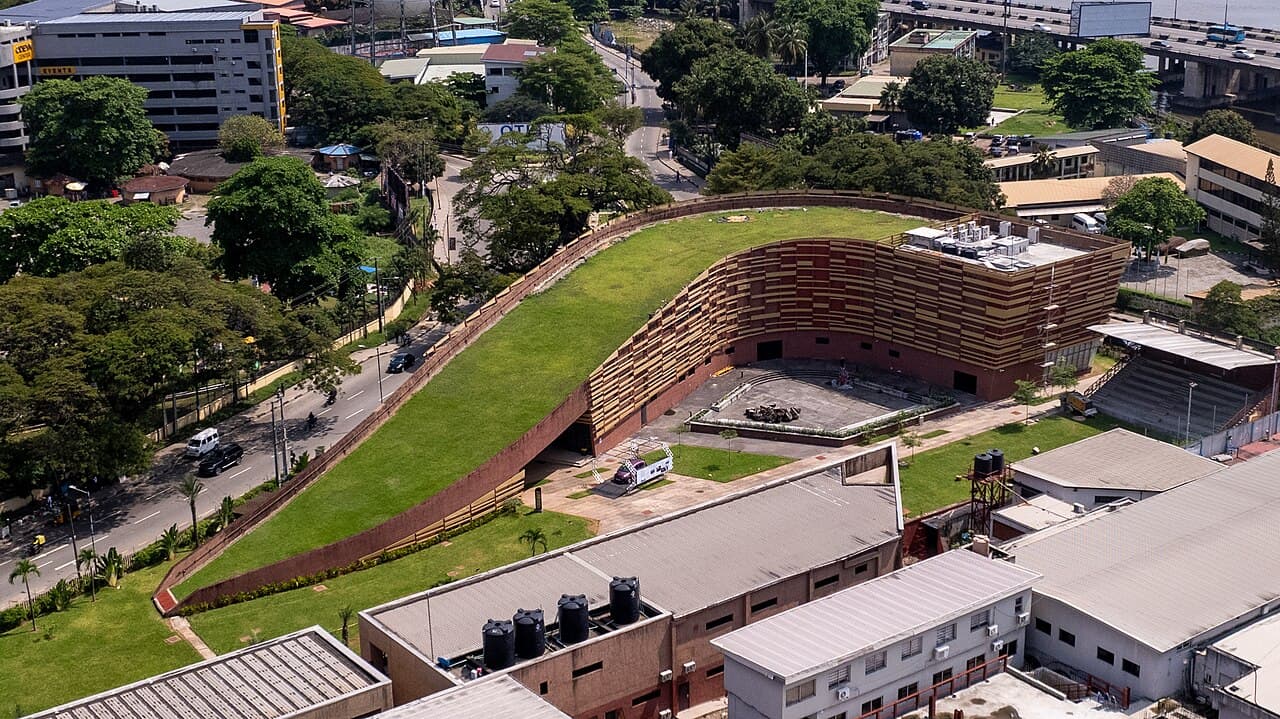
The National Theatre's mandate includes presentation, preservation and promotion of arts and culture. Its programme categories include shows, concerts, workshops, a festival of unity and play readings. The complex also hosts the National Troupe, National Council for Arts and Culture, Centre for Black and African Arts and Civilisation, and National Gallery of Art. It is therefore a cultural campus, not a single auditorium.
- Edifice: architecture, conservation and public landmark.
- Institution: programming, audiences and cultural mandate.
- Complex: several federal arts agencies sharing the grounds.
02
A 1970s design arrived before the festival
The Theatre's official timeline says the construction contract was signed in 1973 with the Bulgarian firm Techno Exportsroy and that the design was inspired by the Palace of Culture and Sports in Varna. It records use from late 1975 and a formal opening on 30 September 1975, before the major international festival that would define the building's early reputation.
The same page gives the building a footprint of 23,000 square metres and a height above 31 metres. Those figures explain its monumental presence, but size alone is not the story. The design gathered stage performance, cinema, exhibition, conference and assembly functions within one national cultural statement.
- Contract signed in 1973.
- Formal opening recorded in 1975.
- Multiple cultural functions were built into the complex.
03
FESTAC made the building a meeting point
The official history identifies the Theatre as a venue for the Second World Black and African Festival of Arts and Culture in 1977. That role matters because it places the landmark inside an international exchange among African and diasporic artists rather than treating it only as a Nigerian prestige project.
FESTAC memory also raises the standard for interpretation. A visitor should ask what the complex enabled people to make, debate and see, not only who inaugurated it. The continuing presence of federal arts agencies on the grounds extends that institutional layer beyond the surviving architecture.
- Read the landmark through gathering and exchange.
- Separate documented festival history from nostalgic exaggeration.
- Look for current programmes that activate the inherited spaces.
04
Restoration answered physical decline
The National Theatre says deterioration led to a large renovation supported through government and the Bankers' Committee, beginning in 2020 and continuing into 2025. Its opening gallery states that work addressed leaking roofs, electrical systems and modernisation. These are the unglamorous systems that determine whether a monumental venue can operate, not decorative footnotes.
Restoration also creates a curatorial question: which materials and qualities express the original building, and which systems must change for present use? The official pages celebrate modernised facilities while describing preservation of architectural integrity. Visitors should recognise that the renewed complex is both conserved heritage and contemporary infrastructure.
- The project addressed building systems as well as appearance.
- Modernisation and heritage preservation were pursued together.
- Operational programming is the test beyond reopening photographs.
05
The new name does not erase the old one
The Theatre records that the restored complex was officially commissioned and rededicated as the Wole Soyinka Centre for Culture and the Creative Arts on 1 October 2025. A separate official page describes the former National Theatre edifice under that name, honouring the Nigerian playwright and Nobel laureate.
Yet the federal institution and its website continue to use National Theatre in their identity and mandate. In practical research, both labels may therefore appear. The responsible approach is not to force one into disappearance, but to specify whether a source is discussing the edifice, the complex or the managing institution.
- Wole Soyinka Centre names the recommissioned edifice and complex.
- National Theatre remains the institutional reference on official pages.
- Use both terms precisely when searching current programmes.
06
The second act needs an audience
A restored shell becomes culturally meaningful through work presented inside it. The official mandate reaches beyond venue rental to theatre, music, exhibitions, readings, training and national cultural agencies. That breadth invites visitors to select a current programme and read the building through the activity it supports.
Do not infer public access to every part of the complex or arrive only because a historical page exists. Check the current official listing and contact the institution when the event index is unavailable. The second act is not a promise that something is always on; it is the renewed possibility that architecture and programme can reinforce each other.
- Choose a verified programme rather than a speculative walk-in.
- Confirm the exact room and entry conditions.
- Allow the work on stage or display to lead the visit.
Useful answers
Reader questions
Is the National Theatre now called the Wole Soyinka Centre?
The restored edifice and complex were recommissioned under the Wole Soyinka Centre for Culture and the Creative Arts name in 2025, while official institutional pages still use National Theatre.
Sources: National Theatre, Nigeria; National Theatre, NigeriaWhat was the Theatre's role in FESTAC '77?
Its official history says it provided venues for the Second World Black and African Festival of Arts and Culture and served as a gathering point for Nigerian and international artists.
Sources: National Theatre, NigeriaWhat did the recent restoration address?
The official opening account mentions leaking roofs, electrical upgrades and broader modernisation after years of disrepair. It does not support assuming that every space is always publicly accessible.
Sources: National Theatre, NigeriaCan visitors enter without an event?
The reviewed pages do not establish unrestricted daily walk-in access to every area. Check the current programme or contact the institution for the specific date and space.
Sources: National Theatre, NigeriaRead the evidence
Sources and further reading
These sources support the relevant sections above. Plans and comparisons are editorial suggestions. Check operators for current arrangements.
- Our Story ↗National Theatre, Nigeria · Research date 14 September 2026
Design, opening, FESTAC role, mandate, restoration timeline, commissioning and the building-institution distinction.
- Wole Soyinka Centre ↗National Theatre, Nigeria · Research date 14 September 2026
The official Wole Soyinka Centre name and its relationship to the former National Theatre edifice.
- National Theatre Opening ↗National Theatre, Nigeria · Research date 14 September 2026
The 2025 reopening record and stated restoration scope.
- About Us ↗National Theatre, Nigeria · Research date 14 September 2026
The theatre's cultural role and the federal arts agencies located on its grounds.